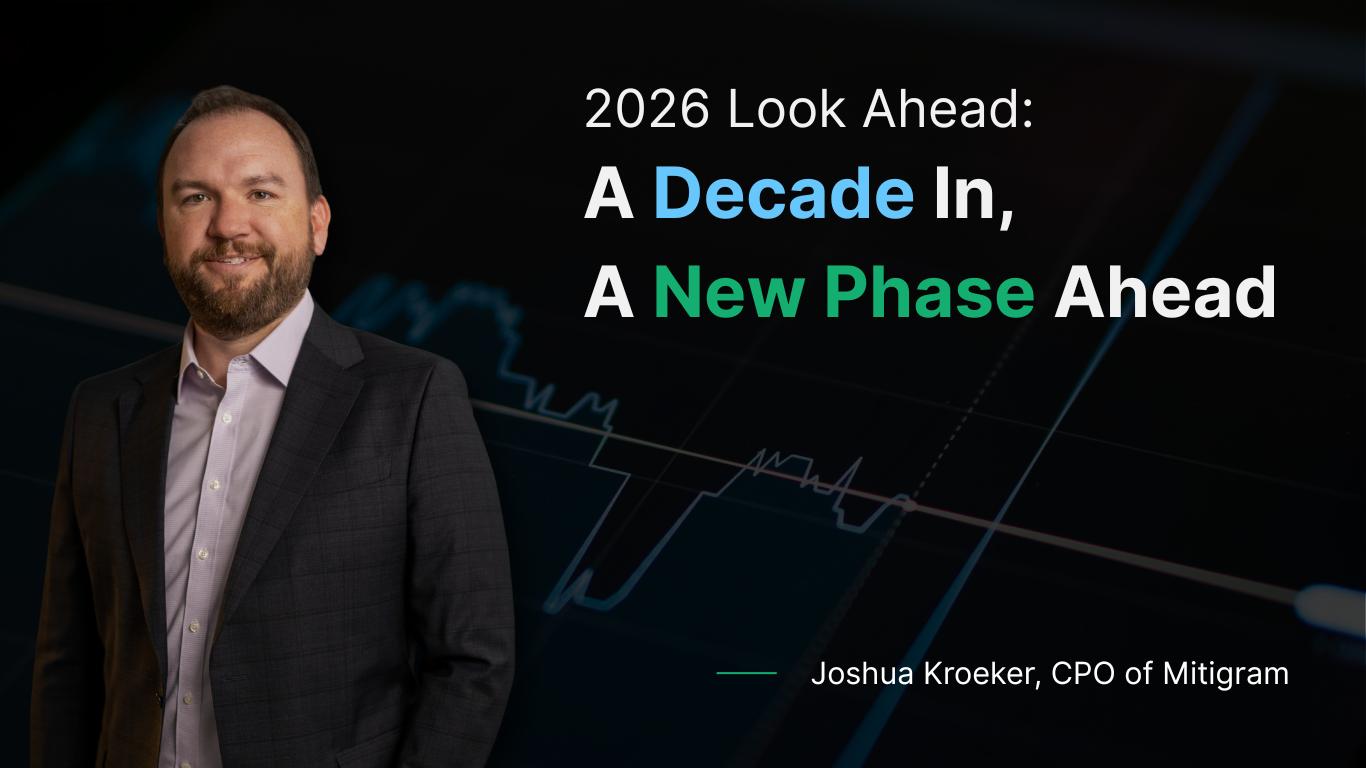
January 7, 2026
2025 has been marked by change and complexity, but also by deeper collaboration and a strengthening ecosystem.
The global economy remains structurally complex. Geopolitics and tariffs continue to reshape supply chains, forcing businesses to rethink how they manage risk, liquidity, and cross-border operations. Trade has not become simpler; it has become more interconnected and less predictable, raising the stakes for how banks and corporates execute and manage trade finance.
Against this backdrop, Mitigram marked its 10th anniversary at GTR Nordics in November – a milestone that reflects a decade of building digital infrastructure and community in trade finance. Collaboration remains central to that journey. This year, we strengthened our ecosystem through strategic partnerships with Nomentia and Complidata.
Nomentia’s treasury and cash management solution helps simplify and standardize how corporates interact with their banking partners, while Complidata’s AI-driven automation reduces the time and cost of document checking and compliance.
Together, these partnerships allow us to offer seamless, end-to-end digital solutions that are redefining trade finance. Our goal is to connect the trade finance community like a family mosaic, fostering a unified structure that is not only highly attractive but increasingly essential for success.
Looking ahead, our focus remains clear: to accelerate the transformation of trade finance for businesses of all sizes by making trade more manageable, transparent, and inclusive.
As we enter the new year, three trends will continue to shape this next phase.
Trade finance has traditionally been shaped by high thresholds, from complex onboarding and specialized knowledge, to entrenched processes that implicitly favor larger corporates. However, it should not be something businesses must navigate complexity before they can participate.
A more sustainable future for trade finance starts by rethinking the first point of entry. In practice, access does not need to be comprehensive or fully embedded from day one. Instead, platforms and institutions can offer gradual engagement, by allowing businesses to explore, learn, and participate incrementally.
Beyond that, opening trade finance ecosystems in this way does more than broaden participation. It creates better-informed users, improves risk understanding over time, and builds trust through experience. In an environment where supply chains are increasingly global and fragmented, lowering the initial barrier is a strategic necessity for resilience and inclusion, and that’s what we, at Mitigram, intend to do.
A common theme across many of the conferences I’ve attended in 2025 was data, and this drive for data insights is shared by both the corporates and the banks. That ability to collect, structure, interpret and securely exchange reliable data is what drives efficiency, compliance and automation.
This was a critical part of what I discussed in my fireside chat with Tony Whiddett of Silver Birch Finance at GTR Nordics in November. The unexpected value of moving on to trade finance platforms is data insights. For banks, the absence of data showing trends in pricing and what their peers are offering makes it difficult to know whether their quotes are in line with the market. For corporates, the lack of data means they can never be sure the rate they’re getting from their banks is fair.
For many institutions, significant value can be unlocked long before full automation: by centralizing data, creating visibility, and surfacing insights that inform risk management and decision-making.
As AI becomes a core driver of operational transformation, its impact will be defined less by algorithms and more by fundamentals. Disciplined data structuring is the first – and most overlooked – step. Without it, automation will be unachievable – and as a result, insights remain shallow, and scale remains out of reach.
In trade finance, where documentation, risk assessment, and compliance intersect, AI’s real value lies in its ability to reduce friction and improve decision-making across complex workflows. But these gains cannot be layered onto fragmented or inconsistent data environments. For this reason, structured, interoperable data is what allows AI to move from isolated efficiency gains to system-wide transformation.
Lasting value from AI goes to organizations will be those that treat it as a capability built on governance, standards, and shared infrastructure. In this context, AI is enabling teams to focus on decision-making and customer relationships, rather than manual reconciliation.
The next chapter in trade finance will be defined by how effectively we apply what we’ve learned from the last decade. When teams build digital infrastructure with discipline, treat data as a strategic asset, and form strong industry alliances, the foundations are in place to transform the way corporates and banks execute global trade.
Execution at scale defines what comes next. It’s about lowering barriers, turning complexity into capability and ensuring that trade finance works not just for the largest players, but for the entire spectrum of businesses that power global trade.
To that end, this is the future Mitigram is actively creating and committed to supporting.

Collaboration to pioneer EBICS-driven trade finance transformation.